How popular is the baby name Ann in the United States right now? How popular was it historically? Use the popularity graph and data table below to find out! Plus, see all the blog posts that mention the name Ann.

The graph will take a few moments to load. (Don't worry, it shouldn't take 9 months!) If it's taking too long, try reloading the page.


Popularity of the baby name Ann


Posts that mention the name Ann

Where did the baby name Dwanna come from in 1936?

Illustration of Dwanna Lee Newman
Dwanna Lee Newman

The name Dwanna first appeared in the U.S. baby name data in 1936:

  • 1938: unlisted
  • 1937: 7 baby girls named Dwanna
  • 1936: 20 baby girls named Dwanna [debut]
  • 1935: unlisted
  • 1934: unlisted

Where did it come from?

A little girl who got hit by a train — and survived!

In October of 1933, a toddler named Dwanna Lee Newman — the daughter of Arvid and Tola Newman of Eureka, Utah — was struck by a train traveling at about 20 miles per hour.

The locomotive pilot knocked her 10 feet in the air, she alighted on the cross-ties exactly between the rails and the entire freight train passed over her. […] When picked up, she was found to be unconscious, but soon revived, and examination disclosed the fact that aside from a bump on forehead, she was uninjured.

Nearly three years later, in July of 1936, Dwanna’s story was featured in the nationally syndicated Ripley’s Believe It or Not newspaper panel.

Sadly, Dwanna died of pneumonia in late 1937, at the age of five. (Arvid and Tola went on to have two more children, daughters Linda Rae and Vicki Ann, in the 1940s.)

What are your thoughts on the baby name Dwanna?

P.S. Believe it or not, the weirdly similar name Dwala was also influenced by Believe It or Not

Sources:

Image: Clipping from the Daily Colonist (16 Jul. 1936)
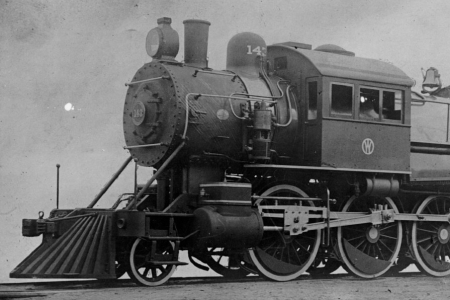
Unusual real name: Leicester Railway

train engine

Sometime during the summer of 1863, Ann and Joseph Cope of Derbyshire, England, welcomed their second child, a baby boy.

He was born in the adjacent county of Leicestershire, and when he was baptized in late August, he was given the name Leicester Railway.

Now, Ann and Joseph weren’t partial to inventive names. Their eldest child was named Ann Lucy, and their later children were named Eliza, John William, and Lucy. So they must have had a good reason to choose something as unusual as Leicester Railway.

I wasn’t able to find Leicester Railway’s birth record, or any mention of him in contemporary newspapers, but I do think it’s safe to assume that he was born at the Leicester railway station while his family (or perhaps just his mother) was traveling.

About a decade ago, an article about odd 19th-century baby names that ran in various British newspapers (e.g., Metro, Mirror, Daily Mail) claimed Leicester Railway Cope was born inside a train car specifically. While this could be the case, we have no way of knowing for certain.

P.S. Leicester is pronounced just like the name Lester.

Sources: FamilySearch.org, Family of Joseph Cope and Ann Wain – Glynn Roe’s Ancestors and Family

Image: Adapted from O&W Engine #143 (public domain)

What popularized Marlo as a girl name in the 1960s?

The character Ann Marie (played by Marlo Thomas) from the TV series "That Girl" (1966-1971)
Marlo Thomas in “That Girl

In the mid-1960s, the unisex name Marlo saw a sudden surge in usage as a girl name:

Girls named MarloBoys named Marlo
1968545 [rank: 396th]28
1967353 [rank: 505th]28
196610127
19651625
19642220

The name went on to feature in the girls’ top 1,000 for more than a decade, from 1967 to 1977. (It also popped into the boys’ top 1,000 a few times during the ’70s, interestingly.)

What was drawing attention to the name Marlo around that time?

Actress Marlo Thomas, star of the sitcom That Girl, which began airing on television in September of 1966.

Marlo played Ann Marie, an aspiring actress living in New York City. (“Marie” was her surname.) Ann was a young unmarried woman living on her own terms — something rarely seen on TV in those days. As Marlo recently said,

All the girls and moms at home wanted to be That Girl: [to] have her own apartment, have fabulous clothes, be getting a job, have a boyfriend, [be] living away from her parents. It was like every girl’s dream.

The compound name Annmarie also saw its highest-ever usage during the five seasons That Girl was on the air.

Marlo Thomas was born Margaret Julia Jacobs in 1937. Her father was entertainer (and St. Jude founder) Danny Thomas, whose legal name was Amos Jacobs — an anglicized form of his Lebanese birth name, Muzyad Yakhoob. She was named after Danny’s mother (Margaret) and aunt (Julia).

How did she come to be called “Marlo”? Here’s how Danny explained it:

So we began to call the infant Margaret, then “Margo,” which we thought would be easier for her to say as she began to speak. It wasn’t easier. The closest she could come to Margo was “Marlo,” as in “Me Marlo.” And that’s how another soon-to-be-well-known stage name was created.

(His own stage name had been created from the names of his youngest brother Daniel and his eldest brother Thomas.)

What are your thoughts on the name Marlo?

Sources:

Image: Screenshot of That Girl

What popularized the baby name Corliss in the 1940s?

The character Corliss Archer (played by Shirley Temple) from the film "Kiss and Tell" (1945)
Corliss Archer from “Kiss and Tell

After re-emerging in the U.S. baby name data in 1943, the name Corliss went on to feature in the girls’ top 1,000 from the mid-1940s to the mid-1950s.

  • 1946: 182 baby girls named Corliss [rank: 591st]
  • 1945: 80 baby girls named Corliss [rank: 843rd]
  • 1944: 70 baby girls named Corliss [rank: 918th]
  • 1943: 44 baby girls named Corliss
  • 1942: unlisted
  • 1941: 6 baby girls named Corliss

(The spelling Corlis also saw higher usage during that period, and Corless was a one-hit wonder in 1947.)

What accounts for the trendiness of Corliss during those years?

A fictional teenage girl named Corliss Archer.

Created by writer F. Hugh Herbert, the “energetic and vivacious” Corliss was introduced in early 1943 as the central character of…

  • A series of six short stories published in the popular women’s magazine Good Housekeeping (starting in January),
  • The radio program Meet Corliss Archer (which also started in January), and
  • The Broadway play Kiss and Tell (which premiered in March).

In 1945, the play was adapted into a film of the same name starring 17-year-old Shirley Temple. The following year (which, admittedly, was the first year of the baby boom) the name Corliss reached peak usage.

Shirley Temple also starred in a second Corliss Archer film, A Kiss for Corliss, which was released in 1949.

The character Corliss Archer from the TV series "Meet Corliss Archer" (1954-55)
Corliss Archer from “Meet Corliss Archer

During the 1950s, the radio program Meet Corliss Archer was adapted to television twice:

  • In the first adaptation, which was broadcast live on CBS from 1951 to 1952, Corliss was played by Lugene Sanders.
  • In the second, which was produced for first-run syndication during the 1954-55 season, Corliss was played by Ann Baker (above).

The radio program itself remained on the air for more than 13 years, until mid-1956.

I’m not sure why F. Hugh Herbert chose “Corliss” as the name of the character. (Perhaps he was inspired by Corliss Palmer?) But I do know that the character was based on his own teenage daughters, Diana and Pamela. He wrote,

I merely had to put into the lips of Corliss some of their more pungent phrases, into the life of Corliss some of their exuberant high spirits, their natural gaiety, bounce, and charm.

Sources:

Image: Screenshots of Kiss and Tell (1945) and Meet Corliss Archer (1954-55)