How popular is the baby name Edgar in the United States right now? How popular was it historically? Use the popularity graph and data table below to find out! Plus, see all the blog posts that mention the name Edgar.
The graph will take a few moments to load. (Don't worry, it shouldn't take 9 months!) If it's taking too long, try reloading the page.
Medgar Evers was an African-American civil rights activist from Mississippi.
On the morning of June 12, 1963, Medgar was assassinated by a white supremacist in front of his own home. He was just 37. Left behind were his wife and three young children (Darrell, Reena and James).
Not coincidentally, the baby name Medgar appeared in the U.S. baby name data for the very first time in 1963. It was the top boy-name debut that year, in fact.
1965: 8 baby boys named Medgar
1964: 13 baby boys named Medgar
1963: 25 baby boys named Medgar [debut]
1962: unlisted
1961: unlisted
The name remained on the list for two more years, then disappeared again. (Spelling variant Medger appeared on the list from 1963 to 1964.)
Evers was named for his great-grandfather Medgar Wright. “The derivation of the name Medgar is unknown, though it was possibly a variation of Edgar.”
Source: Morris, Willie. The Ghosts of Medgar Evers: A Tale of Race, Murder, Mississippi, and Hollywood. New York: Random House, 1998.
So far, she’s the only U.S.-born person I know of with the name Suffrage. (“Suffrage” refers to the right to vote.)
Suffrage’s father had fought for the Confederacy during the Civil War. This suggests to me that her name is a reference to women’s suffrage, not to black suffrage.
That’s just a guess, though. Is anyone out there a descendant who could tell me the real story behind Suffrage’s name?
P.S. Suffrage had siblings named Charles, Carey, Charlotte, Edgar, Isaac and Robert.
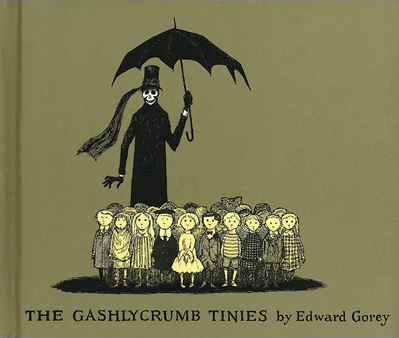
Author Edward Gorey, born on February 22, 1925, would have been 86 today. To celebrate his birthday, let’s check out the names he used in his most famous book, The Gashlycrumb Tinies (1963):
Boy Names
Girl Names
Basil Desmond Ernest George Hector James Leo Neville Quentin Titus Victor Xerxes Yorick
Amy Clara Fanny Ida Kate Maud Olive Prue Rhoda Susan Una Winnie Zillah
He used interesting (sometimes odd) names in his many other books/stories as well, such as Ortenzia, Gertrúdis, Jasper, Ambrogio, Herakleitos, Agnes and Basil in The Blue Aspic (1968), Embley and Yewbert in The Epiplectic Bicycle (1969), Lambert, Amanda, Augustus, Emily and Neville in The Dwindling Party (1982), and Theoda in The Tuning Fork (1983).
Do you happen to own anything by Gorey? If so, please comment with a few character names!
Image: Cover of The Gashlycrumb Tinies by Edward Gorey
I recently came across a BBC article that described how the Norman Conquest drastically changed naming practices in England. Anglo-Saxon names like Aethelred, Eadric, and Leofric were soon replaced by Norman names like William, Robert, and Henry following the 11th-century invasion, which was led by William the Conqueror.
Here’s a quote from the article by English historian Robert Bartlett:
The ruling elite set the fashion and soon William was the most common male name in England, even among peasants. A lot of people changed their names because they wanted to pass in polite society – they didn’t want to be mistaken for a peasant, marked out with an Anglo-Saxon name.
And here are some more details regarding the names, from a later article in The Telegraph:
In Peter Ackroyd’s Foundation, the author notes that on an English farm in 1114 the workers were listed as being called Soen, Rainald, Ailwin, Lemar, Godwin, Ordric, Alric, Saroi, Ulviet and Ulfac. By the end of the century all these names had disappeared.
Because the Normans had conquered England half a century earlier, all these men were easily identifiable as Anglo-Saxons just by their names.
[…]
Of the old English names, only Alfred, Edmund, Edwin and Edgar survived, while Edward thrived, largely thanks to the cult of Edward the Confessor.
The author also mentioned that, per Ackroyd, “a boy from Whitby was recorded as changing his name from Tostig to William because he was being bullied” at the beginning of the 12th century.
And, in case you were wondering about female names, here’s a quote by English historian David Hey:
After the Norman Conquest the personal names that had been popular with the Anglo-Saxons and the Vikings fell out of favour. Some of the names favoured by the Normans were female equivalents of male names, e.g. Joan, Jane, Janet from John, or Patricia, Petra, and Paula from Patrick, Peter, and Paul. Others were biblical names or the names of saints. Joan and Agnes were first recorded in England in 1189, Catherine in 1196, Mary in 1203, Elizabeth in 1205, and Anne in 1218.
Two more female names favored by the Normans were Alice and Matilda.
This website or its third-party tools process personal data.In case of sale of your personal information, you may opt out by using the link Do not sell my personal information.
This website uses cookies to improve your experience while you navigate through the website. Out of these, the cookies that are categorized as necessary are stored on your browser as they are essential for the working of basic functionalities of the website. We also use third-party cookies that help us analyze and understand how you use this website. These cookies will be stored in your browser only with your consent. You also have the option to opt-out of these cookies. But opting out of some of these cookies may affect your browsing experience.
Necessary cookies are absolutely essential for the website to function properly. These cookies ensure basic functionalities and security features of the website, anonymously.
Cookie
Duration
Description
cookielawinfo-checkbox-analytics
11 months
This cookie is set by GDPR Cookie Consent plugin. The cookie is used to store the user consent for the cookies in the category "Analytics".
cookielawinfo-checkbox-functional
11 months
The cookie is set by GDPR cookie consent to record the user consent for the cookies in the category "Functional".
cookielawinfo-checkbox-necessary
11 months
This cookie is set by GDPR Cookie Consent plugin. The cookies is used to store the user consent for the cookies in the category "Necessary".
cookielawinfo-checkbox-others
11 months
This cookie is set by GDPR Cookie Consent plugin. The cookie is used to store the user consent for the cookies in the category "Other.
cookielawinfo-checkbox-performance
11 months
This cookie is set by GDPR Cookie Consent plugin. The cookie is used to store the user consent for the cookies in the category "Performance".
viewed_cookie_policy
11 months
The cookie is set by the GDPR Cookie Consent plugin and is used to store whether or not user has consented to the use of cookies. It does not store any personal data.
Functional cookies help to perform certain functionalities like sharing the content of the website on social media platforms, collect feedbacks, and other third-party features.
Performance cookies are used to understand and analyze the key performance indexes of the website which helps in delivering a better user experience for the visitors.
Analytical cookies are used to understand how visitors interact with the website. These cookies help provide information on metrics the number of visitors, bounce rate, traffic source, etc.
Advertisement cookies are used to provide visitors with relevant ads and marketing campaigns. These cookies track visitors across websites and collect information to provide customized ads.