How popular is the baby name Franklin in the United States right now? How popular was it historically? Use the popularity graph and data table below to find out! Plus, see all the blog posts that mention the name Franklin.
The graph will take a few moments to load. (Don't worry, it shouldn't take 9 months!) If it's taking too long, try reloading the page.
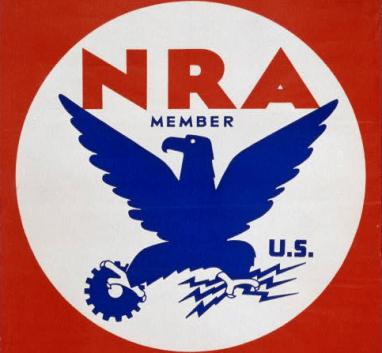
When I wrote about the name Nira yesterday, I was sure to include an NRA poster featuring the Blue Eagle emblem.
Why?
So I could post this follow-up, of course. :)
I’ve discovered two names that were inspired by that Blue Eagle, if you can believe it.
The first is a personal name. Mr. and Mrs. Frank Knapinski of Milwaukee had a baby boy on September 20, 1933. They named him Franklin Delano Blue Eagle Knapinski after both the president and the Blue Eagle.
The second is a (very familiar!) sports name. A National Football League team was formed in Philadelphia, Pennsylvania, in 1933 out of the ashes of the Frankford Yellow Jackets (1899-1931). The new team was named the Eagles after the NRA emblem.
Sources:
Bowen, Les. Philadelphia Eagles: The Complete Illustrated History. Minneapolis: MVP Books, 2011.
The Great Depression began in October of 1929. When Franklin Delano Roosevelt replaced Herbert Hoover as U.S. President in early 1933, he got to work on the New Deal, which was intended to bring immediate economic relief.
Part of the New Deal was the National Industrial Recovery Act (NIRA), which “sanctioned, supported, and in some cases, enforced an alliance of industries.” It was enacted on June 16, 1933.
Soon after, Roosevelt created the corresponding National Recovery Administration (NRA), which was “empowered to make voluntary agreements dealing with hours of work, rates of pay, and the fixing of prices.” Participating businesses were encouraged to display the NRA emblem, the Blue Eagle.
At first, the public was excited by the NIRA and the NRA. So was Hollywood, which put out short films promoting the NRA.
And all this excitement spilled over onto birth certificates.
According to the U.S. baby name data, more than 200 baby girls were named Nira in 1933. This was enough to make Nira the 463rd most popular baby girl name in the nation that year.
1937: unlisted
1936: 9 baby girls named Nira
1935: 12 baby girls named Nira
1934: 38 baby girls named Nira
1933: 201 baby girls named Nira [peak]
1932: unlisted
1931: 8 baby girls named Nira
1930: unlisted
Here’s a visual of the spike:
Usage of the baby name Nira
Newspapers heralded the births of several of these 1933 Niras, including:
Nira Collins, born on July 25th to Mr. and Mrs. Christopher J. Collins of Philadelphia. The father, unemployed for ten months, found work two weeks before she was born.
Nira Davis, born on August 30th to Mrs. Geraldine Davis of Newburgh, New York.
Nira Lavallee, born on September 1st to Mr. and Mrs. George E. Lavallee of Marlborough, Massachusetts. Her father “returned to work after a lengthy period of unemployment soon after her birth.”
Nira Coelho, born on September 25th to Mr. and Mrs. Pedro Coelho of Los Angeles. “The parents are ardent believers in the President’s recovery program.”
One reporter cautioned that, while Nira was “a pretty name,” parents should “take into account the fact that everyone who keeps posted on current national history will know Nira was born in 1933. Which might be embarrassing 25 or 30 years hence.”
The flood of baby Niras prompted at least one person to write to the editor of the New York Times and ask if Washington had offered an “official pronunciation of the name” yet.
But the popular support didn’t last long. The NIRA and the NRA were widely criticized, and ended up doing little to speed up economic recovery. (We can get a feel for how quickly the excitement dried up by looking at the downward trajectory of those SSA numbers: 201, 38, 12.)
The NIRA had been set to expire in June of 1935, but was nullified even earlier when the Supreme Court unanimously declared the NIRA unconstitutional in May of 1935.
Sources:
“Baby Is Named Nira After Father Gets Job.” Hartford Courant 3 Sep. 1933: 2.
“Father Gets a Job; Baby Is Named NIRA.” Telegraph-Herald 27 Jul 1933: 1.
“Named and Dated.” Painesville Telegraph 25 Aug. 1933: 4.
I was just reading The Political Graveyard’s cool list of Politicians Named for Other Politicians. Many of the politicians on the list were named for U.S. presidents, but others were named for figures who aren’t as well-known today. Some examples:
67 politicians were named after Henry Clay (1777-1852).
48 politicians were named after DeWitt Clinton (1769-1828).
43 politicians were named after Winfield Scott* (1786-1866).
21 politicians were named after Abraham Gallatin (1761-1849).
18 politicians were named after Francis Marion (1732-1795).
17 politicians were named after John Jay (1745-1829).
17 politicians were named after John Marshall (1755-1835).
16 politicians were named after Patrick Henry (1736-1799).
14 politicians (and the term “gerrymander”) were named after Elbridge Gerry (1744-1814).
13 politicians were named after Edward Everett (1794-1865).
7 politicians were named after John Calhoun (1782-1850).
Some of those numbers are impressive. Makes me wonder how many baby boys nationwide were named after these men.
*Winfield Scott lost to Franklin Pierce in the 1852 presidential election. One of his namesakes, Winfield Scott Hancock (1824-1886), lost to James Garfield in the 1880 presidential election. Not a lucky name for White House hopefuls, I’d say.
According to the U.S. baby name data, the usage of Garner more than quadrupled in 1932:
1934: 24 baby boys named Garner
1933: 63 baby boys named Garner [rank: 772nd]
1932: 82 baby boys named Garner [rank: 675th]
1931: 19 baby boys named Garner
1930: 16 baby boys named Garner
Why?
Because of the new vice president.
Franklin D. Roosevelt and running mate John Nance Garner III defeated Herbert Hoover (and Charles Curtis) in the 1932 presidential election, held amid the Great Depression.
Garner, popularly known as “Cactus Jack,” was a conservative Democrat from Texas.
The surname Garner has several possible origins, including simply being a shortened form of Gardner.
This website or its third-party tools process personal data.In case of sale of your personal information, you may opt out by using the link Do not sell my personal information.
This website uses cookies to improve your experience while you navigate through the website. Out of these, the cookies that are categorized as necessary are stored on your browser as they are essential for the working of basic functionalities of the website. We also use third-party cookies that help us analyze and understand how you use this website. These cookies will be stored in your browser only with your consent. You also have the option to opt-out of these cookies. But opting out of some of these cookies may affect your browsing experience.
Necessary cookies are absolutely essential for the website to function properly. These cookies ensure basic functionalities and security features of the website, anonymously.
Cookie
Duration
Description
cookielawinfo-checkbox-analytics
11 months
This cookie is set by GDPR Cookie Consent plugin. The cookie is used to store the user consent for the cookies in the category "Analytics".
cookielawinfo-checkbox-functional
11 months
The cookie is set by GDPR cookie consent to record the user consent for the cookies in the category "Functional".
cookielawinfo-checkbox-necessary
11 months
This cookie is set by GDPR Cookie Consent plugin. The cookies is used to store the user consent for the cookies in the category "Necessary".
cookielawinfo-checkbox-others
11 months
This cookie is set by GDPR Cookie Consent plugin. The cookie is used to store the user consent for the cookies in the category "Other.
cookielawinfo-checkbox-performance
11 months
This cookie is set by GDPR Cookie Consent plugin. The cookie is used to store the user consent for the cookies in the category "Performance".
viewed_cookie_policy
11 months
The cookie is set by the GDPR Cookie Consent plugin and is used to store whether or not user has consented to the use of cookies. It does not store any personal data.
Functional cookies help to perform certain functionalities like sharing the content of the website on social media platforms, collect feedbacks, and other third-party features.
Performance cookies are used to understand and analyze the key performance indexes of the website which helps in delivering a better user experience for the visitors.
Analytical cookies are used to understand how visitors interact with the website. These cookies help provide information on metrics the number of visitors, bounce rate, traffic source, etc.
Advertisement cookies are used to provide visitors with relevant ads and marketing campaigns. These cookies track visitors across websites and collect information to provide customized ads.