How popular is the baby name William in the United States right now? How popular was it historically? Use the popularity graph and data table below to find out! Plus, see all the blog posts that mention the name William.

The graph will take a few moments to load. (Don't worry, it shouldn't take 9 months!) If it's taking too long, try reloading the page.


Popularity of the baby name William


Posts that mention the name William

Babies named for the Battle of Trafalgar

Battle of Trafalgar (1805)
Battle of Trafalgar

The Battle of Trafalgar — during which an outnumbered Royal Navy fleet (under Horatio Nelson) soundly defeated a combined French and Spanish fleet (under Napoleon Bonaparte) — took place off the south-western coast of Spain, near Cape Trafalgar, on October 21, 1805.

The battle cost Nelson his life, but the decisive victory “cemented Britain’s reputation as ruler of the seas.”

Dozens of babies in England were given the name “Trafalgar,” typically as a middle, over the next few years. Most of them were boys, but several were girls. Some examples…

  • John Trafalgar Black, b. 1806 in England
  • John Trafalgar Cotton, b. 1807 in England
  • Joseph Trafalgar Dowding, b. circa 1806 in England
  • Jane Trafalgar Grapes, b. 1805 in England
    • Among her siblings were William Nile (b. circa 1798), Charles Wellington (b. circa 1811), and Charlotte Waterloo (b. circa 1815) — likely named for the Battle of the Nile, the Duke of Wellington, and the Battle of Waterloo.
  • William Trafalgar Hannah, b. 1806 in England
  • Richard Trafalgar Hillgrove, b. 1807 in England
  • Robert Trafalgar May, b. 1807 in England
  • Louisa Trafalgar Priske, b. 1805 in England
  • John Trafalgar Salmon, b. 1805 in England
  • Samuel Trafalgar Sparks, b. 1807 in England

A good number of these babies — including Nelson Trafalgar Black (b. 1805 in Scotland) and Horatio Trafalgar Taylor (b. 1806 in England) — were also named in honor of the late admiral.

The Spanish place-name Trafalgar can be traced back to a pair of Arabic words. The first, taraf, means “edge, extremity” (in reference to the cape itself), and the second may mean “west.”

Sources: Battle of Trafalgar – Wikipedia, Battle of Trafalgar – Britannica, Battle of Trafalgar Timeline – National Maritime Museum, Cape Trafalgar – Wikipedia, FamilySearch.org

Image: Adapted from Battle of Trafalgar (1836) by William Clarkson Stanfield
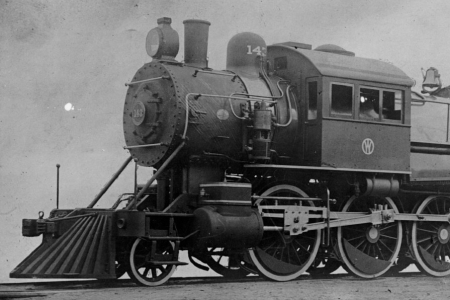
Unusual real name: Leicester Railway

train engine

Sometime during the summer of 1863, Ann and Joseph Cope of Derbyshire, England, welcomed their second child, a baby boy.

He was born in the adjacent county of Leicestershire, and when he was baptized in late August, he was given the name Leicester Railway.

Now, Ann and Joseph weren’t partial to inventive names. Their eldest child was named Ann Lucy, and their later children were named Eliza, John William, and Lucy. So they must have had a good reason to choose something as unusual as Leicester Railway.

I wasn’t able to find Leicester Railway’s birth record, or any mention of him in contemporary newspapers, but I do think it’s safe to assume that he was born at the Leicester railway station while his family (or perhaps just his mother) was traveling.

About a decade ago, an article about odd 19th-century baby names that ran in various British newspapers (e.g., Metro, Mirror, Daily Mail) claimed Leicester Railway Cope was born inside a train car specifically. While this could be the case, we have no way of knowing for certain.

P.S. Leicester is pronounced just like the name Lester.

Sources: FamilySearch.org, Family of Joseph Cope and Ann Wain – Glynn Roe’s Ancestors and Family

Image: Adapted from O&W Engine #143 (public domain)

What gave the baby name Pauline a boost in 1915?

The character Pauline from the film serial "The Perils of Pauline" (1914)
Pauline from “The Perils of Pauline

The rise of the baby name Pauline during the early decades of the 20th century accelerated in the mid-1910s. Pauline reached its highest-ever ranking in 1915, in fact:

  • 1917: 6,896 baby girls named Pauline [rank: 33rd]
  • 1916: 6,655 baby girls named Pauline [rank: 33rd]
  • 1915: 6,334 baby girls named Pauline [rank: 32nd]
  • 1914: 4,698 baby girls named Pauline [rank: 34th]
  • 1913: 3,636 baby girls named Pauline [rank: 35th]
  • 1912: 3,163 baby girls named Pauline [rank: 38th]

What was drawing attention to the name around that time?

Fictional character Pauline Marvin, protagonist of the story The Perils of Pauline, which was serialized in print and on film concurrently throughout most of 1914 (from March to December).

The co-serialization came about through a collaboration between newspaper tycoon William Randolph Hearst and motion picture company Pathé.

Hearst had commissioned Charles Goddard to write the story, in which the main character, a young heiress, set out to “have thrills, adventures, see people, [and] do daring things” before settling down with her sweetheart, Harry. Pauline’s escapades kept going awry, though, due to the scheming of a murderous man intent on stealing her fortune.

The serial’s twenty installments were released biweekly — every other Sunday in the newspapers, and every other Monday in the motion picture houses.

Notably, marketing for the serial included a weekly contest in which Hearst newspaper readers could win sizeable cash prizes for correctly guessing upcoming plot twists.

"The Perils of Pauline" advertisement (Mar. 1914)
The Perils of Pauline” advertisement

The motion picture version of The Perils of Pauline quickly became the most famous of all movie serials. It didn’t utilize cliffhangers to the degree that The Adventures of Kathlyn did, but each episode featured exciting footage such as “the wrecking of a real aeroplane” (in episode 2), a ride in a sabotaged hot air balloon (episode 6), a car crash during a cross-country automobile race (episode 15), and an escape from a sunken submarine (episode 18).

The star of the picture was Missouri-born actress Pearl White, who performed most of her own stunts. The worldwide success of The Perils of Pauline turned White into one of the first international movie stars.

What are your thoughts on the name Pauline? (Do you like it more or less than Pearl?)

P.S. The Perils of Pauline was published as a standalone book in early 1915.

Sources:

Images: Screenshot of The Perils of Pauline (1914), clipping from the New York Times (14 Mar. 1914)

What gave the baby name Kathlyn a boost in 1914?

The character Kathlyn from the film serial "The Adventures of Kathlyn" (1913)
Kathlyn from “The Adventures of Kathlyn

According to the U.S. baby name data, the name Kathlyn saw a steep rise in usage in the mid-1910s:

  • 1916: 86 baby girls named Kathlyn [rank: 731st]
  • 1915: 108 baby girls named Kathlyn [rank: 633rd]
  • 1914: 101 baby girls named Kathlyn [rank: 559th]
  • 1913: 28 baby girls named Kathlyn
  • 1912: 12 baby girls named Kathlyn

Why?

Because of fictional character Kathlyn Hare, protagonist of the story The Adventures of Kathlyn. She was a young American woman who traveled to India to rescue her father, a wild animal collector.

William N. Selig, founder of the Chicago-based motion picture company Selig Polyscope, had commissioned novelist Harold MacGrath to write the tale.

It was serialized in print and on the big screen concurrently, from the very end of 1913 until June of 1914, thanks to an innovative collaboration between Selig Polyscope and the Chicago Tribune newspaper.

"The Adventures of Kathlyn" by Harold MacGrath
The Adventures of Kathlyn

In the newspapers — the Tribune as well as dozens of affiliated papers across the country — a new chapter of The Adventures of Kathlyn was released every week, on Sunday, for 26 weeks.* The chapters were illustrated with films stills and sketches.

In the movie theaters, 13 installments of The Adventures of Kathlyn were released in two-week increments. Notably, at the end of each installment, Kathlyn was left “in some dangerous predicament designed to lure the audience back to see how she would extricate herself.” Cliffhangers — utilized for the very first time (by American filmmakers) in The Adventures of Kathlyn — went on to become a defining feature of motion picture serials.

The film’s heroine was portrayed by, and named after, Selig player Kathlyn Williams (born Kathleen Mabel Williams in Montana in 1879). Its exotic animals (leopards, lions, and elephants, and more) came from William Selig’s extensive animal collection.

Kathlyn Williams Perfume advertisement

The partnership between the newspaper and the motion picture company proved very successful. “Chicago Tribune Sunday circulation jumped almost 80,000, while the motion picture theaters showing Kathlyn were packed.”

As a result, Kathlyn Williams’ name and likeness were used to promote a variety of products (including a perfume, a face powder, a shirtwaist, a waltz, a cocktail, a cigar, and a “watch charm for single men”) throughout 1914, continuing to draw attention to the name Kathlyn even after the synchronized serializations had ended.

What are your thoughts on the name Kathlyn?

*The 26 chapters of The Adventures of Kathlyn were finally published as a standalone book in June of 1914.

Sources:

Images Clippings from Photoplay Magazine (Apr. 1914), Chicago Sunday Tribune (31 May 1914), and Photoplay Magazine (Sept. 1914)