How popular is the baby name Bernice in the United States right now? How popular was it historically? Use the popularity graph and data table below to find out! Plus, see all the blog posts that mention the name Bernice.

The graph will take a few moments to load. (Don't worry, it shouldn't take 9 months!) If it's taking too long, try reloading the page.


Popularity of the baby name Bernice


Posts that mention the name Bernice

What turned Taffy into a baby name in 1943?

The character Taffy Tucker from the comic strip "Terry and the Pirates" (1934-1973)
Taffy Tucker

Taffy isn’t just a type of candy — it’s also a name, and it debuted in the U.S. baby name data in 1943:

  • 1947: 12 baby girls named Taffy
  • 1946: 6 baby girls named Taffy
  • 1945: unlisted
  • 1944: 5 baby girls named Taffy
  • 1943: 6 baby girls named Taffy [debut]
  • 1942: unlisted
  • 1941: unlisted

Why?

Because of Taffy Tucker, a new character introduced in the Terry and the Pirates comic strip during 1942.

Titular character Terry Lee joined the military in 1942, and there he met new people, including Taffy Tucker, an Army nurse, and Flip Corkin, an Army flight instructor (who was also Taffy’s boyfriend).

Taffy Tucker was a “spunky, dedicated nurse, hardworking and tireless, cheerful and caring and always feminine.”

At one point in the storyline, Taffy was kidnapped by a Japanese agent. She was beaten and left for dead in the interior of China. Thankfully, she was eventually rescued by Terry and Flip.

It took cartoonist Milton Caniff about three months to create the character:

[He] spent several days just worrying about a name for Taffy. Since he visualized her as a pert, snub-nosed girl from Georgia, he wanted a name with a typically Old South sound. He finally settled on Guinevere Marianne Tucker, nicknamed Taffy because of her candy-colored hair. She had to be short, because she was scheduled to fall in love with Flip Corkin, who is short, and she had to be blond [sic] for contrast with Flip, who is dark.

Caniff had modeled Taffy after a photo of real-life WWII military nurse Bernice Taylor of Kansas.

What do you think of Taffy as a baby name?

P.S. The name Taffy got a slight boost around 1949 thanks to the film The Doctor and the Girl, in which the young Dr. Corday has a love interest named Evelyn “Taffy” Heldon who operates a taffy machine in a candy store.

P.P.S. Other Terry and the Pirates-inspired baby names include Normandie, Merrily, and Raven.

Sources:

Image: Adapted from the cover of Terry and the Pirates trade paperback #18 (published by Flying Buttress)
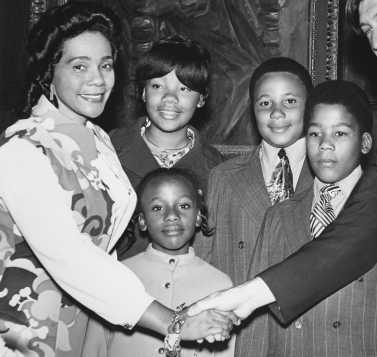
What gave the baby name Coretta a boost in 1968?

Civil rights activist Coretta Scott King with her four children (Yolanda, Bernice, Martin III, Dexter) in 1971
Coretta Scott King and family

The baby name Coretta was the fastest-rising baby name of 1968:

  • 1970: 146 baby girls named Coretta [rank: 903rd]
  • 1969: 194 baby girls named Coretta [rank: 722nd]
  • 1968: 336 baby girls named Coretta [rank: 523rd]
  • 1967: 13 baby girls named Coretta
  • 1966: 16 baby girls named Coretta

The name also saw it’s highest-ever usage that year, as did the variant spelling Corretta. And another spelling, Koretta, appeared for the very first time in the data in 1968.

What was bringing all this attention to the baby name Coretta in 1968?

Coretta Scott King. She was the wife of civil rights leader Martin Luther King, Jr., until his assassination on April 4, 1968, in Memphis, Tennessee. This event put Coretta and her children (Yolanda, Martin III, Dexter, and Bernice*) in the national spotlight.

Not long after the death of her husband, Coretta took Martin’s place as a leader of the Civil Rights Movement. She was instrumental in establishing the national holiday Martin Luther King, Jr. Day — which happens to be today.

Coretta Scott King was named in honor of her paternal grandmother, Cora. The name Cora is a Latinized form of the ancient Greek name Kore (“maiden”), one of the epithets of the goddess Persephone.


*Usage of the names Yolanda and Dexter also increased markedly in 1968. The usage of Martin, which had been declining, saw an uptick that year. (Peak usage was in 1963, the year of MLK’s legendary “I have a dream” speech.) The usage of Bernice was seemingly unaffected by the assassination.

Incidentally, in her 1969 book My Life with Martin Luther King, Jr., Coretta Scott King talked about the naming of her daughters Yolanda (nicknamed Yoki) and Bernice:

I chose the name Yolanda Denise, but my husband had reservations about it. He questioned whether people would call her Yolanda or would mispronounce the name. He was right. Her name is so frequently mispronounced that it bothered her when she was growing up.

There is a tendency among middle-class African Americans to give their children unusual names. Perhaps they are seeking elegance or some special identification. I fell victim to this custom, rather than following the sensible practice of naming the baby after a member of the family. Later Martin said, “If we ever have another baby girl, I’m going to give her a simple name like Mary Jane.”

When we did have another daughter, we called her Bernice Albertine, after her two grandmothers. Her name was not quite Mary Jane, but at least she was named for members of the family.

Sources: Coretta Scott King – Wikipedia, Cora – Behind the Name, SSA

Image: Adapted from Coretta Scott King and family with NEC President Gunther Schuller by New England Conservatory Archives under CC BY-SA 4.0.

Names popular during the Victorian Era

Photo of a Victorian-era baby

Tuesday’s post about the Victorian-style Tylney Hall Hotel reminded me of a list of Victorian-era names that I’ve had bookmarked forever.

The list was created by amateur genealogist G. M. Atwater as a resource for writers. It contains names and name combinations that were commonly seen in the U.S. from the 1840s to the 1890s. Below is the full list (with a few minor changes).

Victorian Era Female NamesVictorian Era Male Names
  • Abigale / Abby
  • Ada
  • Adella
  • Agnes
  • Allie
  • Almira / Almyra
  • Alva
  • America
  • Amelia
  • Ann / Annie
  • Arrah
  • Beatrice
  • Bernice
  • Charity
  • Charlotte
  • Chastity
  • Claire
  • Constance
  • Cynthia
  • Dorothy / Dot
  • Edith
  • Edna
  • Edwina
  • Ella
  • Eleanor
  • Ellie
  • Elizabeth / Eliza / Liza / Lizzy / Bess / Bessie / Beth / Betsy
  • Elvira
  • Emma
  • Esther
  • Ethel
  • Eudora
  • Eva
  • Fidelia
  • Frances / Fanny
  • Flora
  • Florence
  • Geneve
  • Genevieve
  • Georgia
  • Gertrude / Gertie
  • Gladys
  • Grace
  • Hannah
  • Hattie
  • Helen
  • Helene
  • Henrietta / Hettie / Ettie
  • Hester
  • Hope
  • Hortence
  • Isabell / Isabella
  • Jane
  • Jennie
  • Jessamine
  • Josephine
  • Judith
  • Julia
  • Juliet
  • Katherine / Kate
  • Laura
  • Leah
  • Lenora
  • Letitia
  • Lila
  • Lilly
  • Lorena
  • Lorraine
  • Lottie
  • Louise / Louisa
  • Lucy
  • Lulu
  • Lydia
  • Mahulda
  • Margaret / Peggie
  • Mary / Molly / Polly
  • Mary Elizabeth
  • Mary Frances
  • Martha
  • Matilda / Mattie
  • Maude
  • Maxine / Maxie
  • Mercy
  • Mildred
  • Minerva
  • Missouri
  • Myrtle
  • Nancy
  • Natalie
  • Nellie / Nelly
  • Nettie
  • Nora
  • Orpha
  • Patsy
  • Parthena
  • Permelia
  • Phoebe
  • Philomena
  • Preshea
  • Rachel
  • Rebecca / Becky
  • Rhoda / Rhody
  • Rowena
  • Rufina
  • Ruth
  • Samantha
  • Sally
  • Sarah
  • Sarah Ann
  • Sarah Elizabeth
  • Savannah
  • Selina
  • Sophronia
  • Stella
  • Theodosia / Theda
  • Vertiline / Verd
  • Victoria
  • Virginia / Ginny
  • Vivian
  • Winnifred / Winnie
  • Zona
  • Zylphia
  • Aaron
  • Abraham / Abe
  • Alan / Allen
  • Albert
  • Alexander
  • Alonzo
  • Ambrose
  • Amon
  • Amos
  • Andrew / Drew / Andy
  • Aquilla
  • Archibald / Archie
  • Arnold
  • Asa
  • August / Augustus / Gus
  • Barnabas / Barney
  • Bartholomew / Bart
  • Benjamin
  • Bennet
  • Benedict
  • Bernard
  • Bertram / Bert
  • Buford
  • Byron
  • Calvin
  • Cephas
  • Charles / Charley / Charlie
  • Christopher
  • Christopher Columbus
  • Clarence
  • Clement / Clem
  • Clinton / Clint
  • Cole
  • Columbus / Lom / Lum
  • Commodore Perry
  • Daniel / Dan
  • David
  • Edmund
  • Edward / Ned
  • Edwin
  • Eldon
  • Eli
  • Elijah
  • Elisha
  • Emmett
  • Enoch
  • Ezekiel / Zeke
  • Ezra
  • Francis / Frank
  • Franklin
  • Frederick / Fred
  • Gabriel / Gabe
  • Garrett
  • George
  • George Washington
  • Gideon
  • Gilbert / Gil
  • Granville
  • Harland
  • Harrison
  • Harold / Harry
  • Harvey
  • Henry / Hank
  • Hiram
  • Horace
  • Horatio
  • Hugh
  • Isaiah
  • Israel
  • Isaac / Ike
  • Isaac Newton
  • Jacob / Jake
  • James / Jim
  • Jasper
  • Jefferson / Jeff
  • Jedediah / Jed
  • Jeptha
  • Jesse
  • Joel
  • John / Jack
  • John Paul
  • John Wesley
  • Jonathan
  • Joseph / Josephus
  • Josiah
  • Joshua
  • Julian
  • Julius
  • Lafayette / Lafe
  • Lawrence / Larry
  • Leander
  • Les / Lester / Leslie
  • Lewis / Lew / Louis
  • Levi
  • Lucas
  • Lucian
  • Lucius
  • Luke
  • Luther
  • Louis
  • Levi
  • Lucas
  • Lucian
  • Lucius
  • Luke
  • Luther
  • Matthew
  • Marcellus
  • Mark
  • Martin
  • Martin Luther
  • Masheck
  • Maurice
  • Maxwell
  • Merrill
  • Meriwether
  • Meriwether Lewis
  • Michael / Mike
  • Micajah / Cage
  • Mordecai
  • Morgan
  • Morris
  • Nathaniel / Nathan / Nate / Nat
  • Newton / Newt
  • Nicholas / Nick
  • Nimrod
  • Ninian
  • Obediah
  • Octavius
  • Ora / Oral
  • Orville
  • Oscar
  • Owen
  • Paul
  • Patrick / Pat
  • Patrick Henry
  • Paul
  • Perry
  • Peter
  • Pleasant
  • Ralph
  • Raymond
  • Reuben
  • Robert / Bob
  • Robert Lee
  • Richard / Rich / Dick
  • Roderick
  • Rudolph
  • Rufus
  • Samuel
  • Sam Houston
  • Seth
  • Silas
  • Simon
  • Simeon
  • Stanley / Stan
  • Stephen
  • Thaddeus
  • Thomas / Tom
  • Thomas Jefferson
  • Theodore / Ted
  • Timothy / Tim
  • Ulysses
  • Uriah
  • Victor
  • Walter
  • Warren
  • Washington
  • Wilfred
  • William / Will / Bill / Billy
  • Willie
  • Zachariah
  • Zebulon
  • Zedock

Which female name and male name do you like best?

Source: Victorian Era Names, A Writer’s Guide

Irish names from the Middle Ages: Dubchoblaig, Flaithbertach, Mór

Cliffs of Moher, Ireland

I’ve always thought of mór (as in an Gorta Mór) simply as an Irish vocabulary word. So I was a bit surprised to learn that it was once used as a female name:

In the late middle ages, the name Mór (meaning great or big) was very popular for a woman. Although given the 21st­ century obsession with being skinny, it’s diffi­cult to see that one making a comeback.

That quote comes from “The Name Game” by Bernice Mulligan, published in yesterday’s edition of the Irish Independent.

According to Irish Names by Donnchadh Ó Corráin and Fidelma Maguire, the following names were also popular in Ireland during the Middle Ages:

FemaleMale
Affraic
Barrdub
Caíntigern
Dubchoblaig
Echrad
Forbflaith
Gormlaith
Lerben
Márgrég
Nárbflaith
Órnat
Ragnailt
Suaibsech
Tailltiu
Uallach
Anmchaid
Báethgalach
Cuilén
Donndubán
Echmhílidh
Flaithbertach
Gáethíne
Loingsech
Mathgamain
Nuadu
Ólchobar
Rechtabra
Sitric
Tairdelbach
Uillec

And I thought modern Irish names were intimidating.

Image: Adapted from Cliffs of Moher 3 by Carogonmu under CC BY-SA 4.0.